
Put your defences to the test with Continuous Security Validation

Penetration Testing can be a great way to test your network for weaknesses and identify any uncovered vulnerabilities. The results are then used to shore up weak areas that hackers could exploit, not to mention that many security standards require periodic testing from qualified companies. However, if your test is only performed annually or at the start of a project, it can leave you open to cybercriminals who regularly update and change their attack methods, sometimes on a daily basis. New threats are constantly popping up, and you need to be sure you can challenge attacks to ensure the safety of your valuable data and information. This is where Continuous Security Validation technologies can help.
What is Continuous Security Validation?
Continuous Security Validation, from companies such as Cymulate, test your internal and external defences against the latest threats and can be customised to your exact needs, making it simple to measure and track your security posture across the business and even 3rd parties. Continuous Security Validation also helps to easily identify weaker areas of your infrastructure needing further investment or changes. You receive your results in minutes and can sleep easily knowing that your defensive infrastructure can withstand whatever threats are made.
The Benefits of Continuous Security Validation?
Visibility is everything for cyber security teams. Having access to immediate, up-to-date reports provides total visibility of security gaps before they can be taken advantage of. Organisations are able to assess their security posture on an ongoing basis, with the latest data and insights at their fingertips. Cymulate even offers actionable remediation guidance, helping you to quickly deploy effective solutions to the issues raised in your reports. 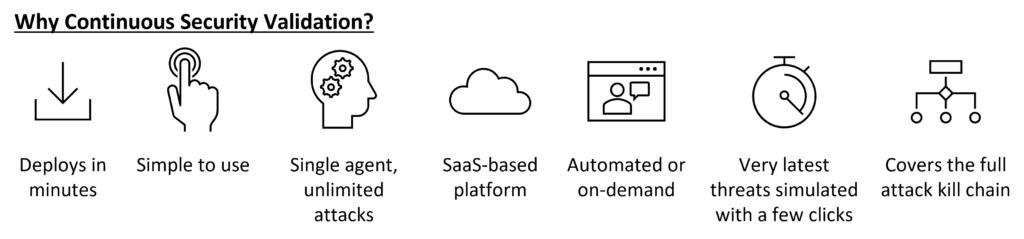 For organisations looking for support in meeting compliance and regulatory standards, such as ISO 27001, Continuous Security Validation technology, in partnership with thorough penetration tests and vulnerability management technology, can be a godsend. We offer a range of security solutions that follow the Predict, Prevent, Detect & Respond methodology. See how effective your security really is before it’s too late with Espria.
You may be interested in

Is Your Office Printer a Way In for Cybercriminals?
Most small businesses think of cyber security as a laptop problem, a server problem, or an email problem. The office printer rarely gets a mention, yet it is connected to your network, holds a hard drive, and processes some of the most sensitive documents in the business, from invoices to HR letters and client contracts. However, it is important to realise that office printer vulnerabilities can be exploited by cybercriminals, potentially leading to cyber attacks. A modern multifunction printer is a computer. It has an operating system, a network connection, often Wi-Fi, and increasingly a…
The Cyber Resilience Act: what it means for your business
By Stephen Cook From 11th September 2026, a new EU regulation starts changing how connected products and software are built, sold and supported – and UK businesses trading into Europe are firmly in scope [1] [2]. Here is what the Cyber Resilience Act actually requires, why it matters beyond the compliance paperwork, and how Espria helps clients meet it. What is the Cyber Resilience Act? The Cyber Resilience Act (CRA) is an EU regulation – Regulation (EU) 2024/2847 – that sets mandatory cybersecurity requirements for “products with digital elements.” In practice, this covers hardware and software that can connect to a device or network: IoT devices,…

The Hidden Costs of Printing: How Managed Print Services Reduce Business Waste
Introduction For many organisations, printing is viewed as a routine operational expense. Printers are purchased, toner is replaced when needed, and documents continue to flow through the business without much scrutiny. However, the true cost of printing extends far beyond paper and ink. Unmanaged print environments often create hidden expenses through inefficient device usage, excessive energy consumption, IT support demands, security risks, and employee downtime. These costs can accumulate significantly over time, impacting productivity and profitability. This is particularly relevant as businesses seek to optimise operations, reduce waste, and improve sustainability while controlling expenditure. Whether…

Can Your Business Actually Recover? The Operational Resilience Question Most SMEs Cannot Answer
Operational resilience is not a technology problem. It is a business problem. And until boards and leadership teams own it, no amount of IT investment will be enough. The Gap Between Confidence and Reality Most organisations believe they are more resilient than they are. The backups are running. The antivirus is licensed. The IT team knows what they are doing. That confidence, in our experience, rarely survives first contact with an actual incident. The question is not whether your systems are protected. The question is whether your business can keep delivering its most important services…

Why the Sophos–Microsoft Partnership Matters – Especially for Education, Financial Services and Legal Organisations
For most organisations today, Microsoft is the foundation of how you operate and on top of this there is also a requirement for regulatory compliance and operational resilience. Whether it’s Microsoft 365 for collaboration, Teams for communication, or Azure for infrastructure, these platforms sit at the heart of day-to-day business. But for sectors like Education, Financial Services, and Legal, that reliance comes with heightened risk, and responsibility. These organisations are not only prime targets for cyber attackers, they are also subject to strict regulatory, data protection and governance obligations. That’s why the partnership between Sophos…

Why Cyber Resilience Can’t Be Audited Once a Year: Lessons from the UK Cyber Action Plan
Moving from box‑ticking compliance to real‑world cyber readiness Written by Richard Puckey Cyber security has a confidence problem For years, many organisations have taken comfort in annual cyber audits, certifications and compliance checklists. Pass the audit, tick the box and move on. On paper, everything looks secure. The problem? Cyber threats don’t operate on an annual cycle. The UK’s Cyber Action Plan is a clear signal that this approach is no longer enough. It challenges businesses to rethink cyber security not as a periodic compliance exercise, but as a living, breathing capability and culture that must stand up…